
Details
Build. Grow. Achieve.
Infrastructure Projects Provide Robust Investment Momentum
GCC States Forging Ahead with Infrastructure Investments Despite Economic Challenges
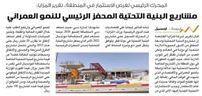
Large-scale infrastructure projects play a major role in a country’s drive for development. They are inseparably associated with urban growth and development, as manifested through the economies of the Gulf region. Such enterprises are conducive to opening up fresh vistas of investment, ultimately resulting in strengthening the economy.
In its weekly report, Al Mazaya Holding summarised the benefits of infrastructure projects as follows: developing economy-strengthening plans and strategies; providing an investment momentum; enabling economies to survive challenges; coping with economic changes, developments and variables; providing investors with sufficient business opportunities; and creating an investment-friendly environment.
The report added that despite the financial and economic pressures, the region’s countries are forging ahead with their developmental and expansion infrastructure plans, and are set to launch new projects over the coming period to enhance their competitive edge and bolster their investment-friendly environment.
The report mentioned that infrastructure-strengthening efforts are a primary step for any development to materialise in a way that should reflect positively on all services available in a country. The efforts are also paving the way to develop investment-enticing legislations and policies conducive to creating job opportunities and grooming local cadres as well as fostering a culture of innovation.
According to the report, the infrastructure projects in the UAE have set a remarkable example for the community. They provide growing incentives and momentum to the country’s endeavours to overcome the multi-faceted challenges it is facing, thus strengthening its position as a premier investment destination at the regional and global levels. The report cited recent statistics purporting that the UAE comes on top of MENA countries with regards to the number of infrastructure projects up to the year 2020, with Abu Dhabi launching infrastructure projects worth AED 4.3 billion out of AED 17.5 billon allocated to capital-intensive projects in the emirate. Dubai’s infrastructure developments are valued at more than AED 22 billion for the current year.
On Qatar, the report stated that the infrastructure investment momentum is almost on par with that of Dubai, as the latter is gearing up to EXPO 2020, while the former is getting ready for the 2022 FIFA World Cup. These are premier world events that are considered main catalysts for urban development, driving up demand for infrastructure projects at present and over the coming period.
By 2020, Qatar is planning to spend around QAR 30 billion on highways, bridges, subways and power generation station projects in addition to FIFA World Cup-related infrastructure projects worth $ 200 billion. Qatar’s new budget indicated an increase to around QAR 100 billion in government spending on major projects in areas of education, health and so on.
On Saudi Arabia’s infrastructure projects, the report mentioned that they are closely linked to the government’s economic diversification plans and strategies as part of the Saudi Vision 2030. In this regard, the report said that the resilience and buoyancy of the Saudi economy and the Kingdom’s massive financial reserves coupled with the considerable future credit flows are all significant factors to ensure that KSA makes great economic strides, provided feasible investment plans are developed.
The report referred to recent statistics indicating that KSA is planning to spend around SAR 630 billion on infrastructure projects over the coming few years – this is out of SAR 3.75 trillion worth of projects allocated to primary economic sectors, including railway, road and airport enterprises. In the meantime, the Saudi government is reappraising a number of projects in-line with its economic diversification strategy. Therefore, it has stopped funding major projects valued at around $ 267 billion, including infrastructure projects whose returns are not aligned with the new strategy.
In the meantime, the Bahraini government is planning to continue spending on large-scale infrastructure projects in order to further strengthen its investment-friendly environment and boost urban development.
The growth recorded by non-oil economic platforms in Bahrain has resulted in increasing job opportunities. Infrastructure investments are valued at more than $ 6 billion, in addition to the newly introduced investments that are valued at around $ 5 billion. These investments have reflected positively on the construction, real estate and tourism sectors in the kingdom.
The report also underlined the necessity of linking infrastructure investments in the Gulf countries with tangible projects conducive to providing full support to the region’s economy in the future, calling for a reconsideration of the potential investments in accordance with the allocated budgets. The report noted that integrated strategies capable of drawing foreign investments are a must to maximise financial revenues.
Conclusion
The report concluded by highlighting that the region’s countries should show full commitment to overcoming financial challenges faced by infrastructure investments as their potential returns are conducive to achieving future economic objectives set by the GCC states.
Clippings