
This post is also available in: العربية (Arabic)
The real estate market is undoubtedly one of the most dynamic markets in the global scenario, and Al Mazaya Holding Company ensures that you remain updated about the latest developments and trends in the property market. We invite you to browse through our exhaustive media library to know more about global and regional markets so that you are in a position to make informed decisions when it comes to your property investments.
Al Mazaya Holding Report to “Al Youm KSA”
Lack of unified framework ensuring quality of products exacerbates the problem
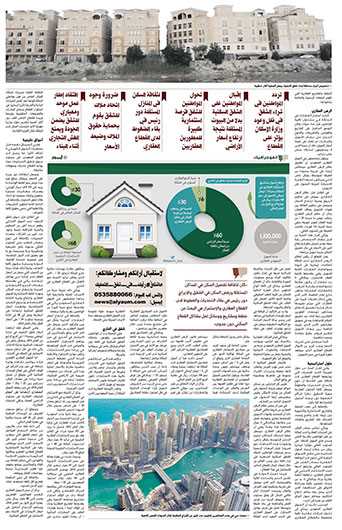
“Al Mazaya Holding Company” highly considered our monthly file monthly, «Apartment Ownership…Coming Urban Slums », and delivered a special report about circumstances and future prospects of the real estate market in general and the Apartment Ownership Sector. Engineer Ibrahim Al Saq’abi, the Group CEO of Al Mazaya Holding, pointed to the public demand for apartments rather than villas and independent houses, as a result of the continuous rise recorded on land prices – which in many cases amount to more than 60% of the total cost of property. The need for monitoring the KSA Apartment Ownership Market was stressed, due to the growing fears of negative practices of imposing impossible conditions on citizens to buy housing units, in addition to the lack of a unified and standard framework for apartments which ensures the quality of products and avoids commercial fraud during construction, due to the lack of an owner union or specialized agencies to protect owners’ rights and set high prices.
The report showed that it is not feasible for the Ministry of Housing to supervise the implementation of apartment ownership projects and complete the “Land & Loan” project. Rather, the establishment of an owners union will be more feasible for the apartment ownership market in particular and the real estate market in general.
It also attributed the reasons for high prices of real estate products to speculation, monopoly, the absence of advanced global and local real estate corporations, and the disruption of forces of supply and demand. It pointed out that the real estate institutions and offices in the market do not fit the requirements of the current stage, and will not achieve the required balance due to their focus on maximizing profits regardless of the negative impacts of these trends on the stability of the real estate market.
The report called for a radical change in the prevailing general culture and for the trend towards properties that fit the income level, whether for ownership or tenancy. It also called for the establishment of further REITs in KSA to keep pace with the growth of real estate activity – which is expected to reach 6% – and stressed the importance of taking the experiences of countries to save the KSA Apartment Ownership Sector and find long-term radical solutions for housing challenges.
Promising opportunities
The report indicated thatthe investment opportunitiesoffered by thereal estate sectorin KSA are abundant and promising. It pointed to the needs, requirementsandnecessary solutionsto overcome the challengesand obstaclesfaced by theSaudi real estate market, at the level ofthe price rise recorded on the real estate products and lands, the rise recorded on house pricesand mechanisms ofaccess to finance, etc.
It touched on the various projects and initiatives of government and private sectors that are being implemented in KSA to calm the real estate market and strike balance between the forces of supply and demand, stressing that these projects are designed to meet citizens’ demand for housing. However, the available data reflect the continuing pressures, obstacles and exclusion of achieving abundance in supply that suits the demand indicators that are difficult to anticipate in the Saudi market in particular, because the increase in population and the large income variation between one class and another – and between one region and another – do not fit the acceleration of the prevailing prices of all types and sizes of real estate products.
The weakness of saving culture in the KSA and the trend towards funding, borrowing or waiting for government projects by qualified categories, contribute to deepen challenges and resolve them in the foreseeable future. The investment in the Saudi real estate market involves future promising prospects and continuing changes that benefits all parties. The indicators show that the market continues its progress and the coming period will see a great role of the private sector to overcome the challenges faced by the real estate market, and support projects and initiatives of the government agencies for the completion of projects.
The real estate sector will see a new real estate boom as a result of the higher volume of funding pumped into the housing sector during the coming period. For example, the government agencies will implement housing projects of building 500,000 housing units amounting to SR 250 billion, and they will be granted to the beneficiaries in accordance with the conditions and standards of the Ministry of Housing. The real estate market will also benefit from the mortgage system that will enable citizens to own housing units that meet their ambitions, with the estimated volume of the mortgage granted to members reaching up to SR 70 billion at the end of the year 2013.
The annual demand for housing is estimated at 250,000 units over the next five years, in addition to the positive effects of the continued implementation of infrastructure projects, the establishment of economic cities and expansion of networks of Transport and Communications in the real estate sector. The KSA real estate market urgently needs to provide individuals and developers with funding sources, so they can overcome challenges pertaining to the necessary liquidity and finance their projects to be completed on time.
Turning to apartments
Indicators of the real estate market in the KSA reflect the rapid developments and changes that are consistent with the acceleration of the price index and evolution of the real estate products. The market data indicate a large turnout of citizens to own apartments, rather than villas, and independent houses as a result of the continuing rise of land prices that in many cases reach more than 60% of the total cost of the property.
- Ibrahim Al Saq’abi, Group CEO of Al Mazaya Holding Company, stressed that apartment ownership is considered one of the best possible solutions at this time in light of the continuing rise of prices of lands and villas, in addition to the inability to provide all requirements to obtain financing from banks. Turning to apartments is a great investment opportunity for real estate developers due to the low risk of loss and high demand, since apartment ownership is affordable for citizens of all classes and their prices are still acceptable and meet the needs of small and medium-sized families.
Al Saq’abi said that the trend of making essential adjustments in the building permits and licenses that increase the number of roles will provide more housing units in the same site, which strikes a balance between supply and demand which is directly mirrored on prices. He added that the apartment ownership is an investment option to be added to the ownership alternatives for small families, since current demand involves investment options by businessmen, due to the feasibility of leasing housing units that are purchased for investment.
Demand fluctuation
The Apartment Ownership Sector goes through volatility and instability of demand as a result of citizens’ hesitation to purchase apartments, due to the promises of the Ministry of Housing to build 500,000 housing units. It is to be stressed that the plans and programs that have been adopted will not meet all kinds of demand.
Specialized reports indicate the market’s need for more than 1.1 million units. However, “Land & Loan”, the initiative of the Custodian of the Two Holy Mosques, will contribute to decrease prices, increase the quality of real estate products, and display them at affordable prices that fit the conditions of all sources of demand.
In spite of postponing the investment in housing apartments, their prices are expected to rise by up to 10%, while the market undergoes fears of unjustifiable price rises of apartment ownership and their possible low quality. This is in light of the absence of clear and specific programs and mechanisms to implement projects of the Ministry of Housing, and the growing demand for residential units, in addition to the high prices of manpower in 2013, and the continuous price rise of construction materials.
Owner Union
To Eng. Ibrahim Al Saq’abi, the application of the real estate mortgage and funding, supporting developers, and the establishment of further banks specialized in the real estate sector and housing, will contribute to pumping more apartments with moderate prices and high quality, and will also pave the way towards further partnership between the public and private sectors to strike a balance.
Al Saq’abi stressed the need for monitoring the apartment ownership market in the KSA, due to the growing fears of negative practices represented by impossible conditions imposed on citizens to buy housing units. This is in addition to the lack of a unified and standard framework of the apartments that ensures the quality of products and avoids the commercial fraud processes during construction, due to the lack of an owner union or specialized agencies that protect the rights of the owners and set high prices.
It has been infeasible for the Ministry of Housing to supervise and monitor the implementation of apartment ownership projects, and complete the “Land & Loan” Project. The establishment of an owner union will remain more feasible and influential on the apartment ownership market in particular and the real estate market in general.
Al Saq’abi stressed that the need for an owner union is important in light of the growing number of citizens to own housing apartments, in addition to the owner union’s ability to adopt many regulations and requirements that will properly protect residential units to preserve their market values, reduce deterioration of their situation, and give them default longevity for symbolic fees and commissions.
The activation of the owner union will have a significant impact on settling disputes between owners and reducing the trend towards settling disputes before court.
Inlight of the challengesfaced bythe Saudi citizensto gainadequate housing, and in light of theshift towardsowninghousing apartments as one of the more feasible options in resolving the housing challenges, it is essential thatthe relevant official agenciesimpose an owner uniononall residential units – andconsider it mandatoryandnot optional – so as to assert the success ofthe experience and circulate it toallcities andneighborhoods, in addition to following its application due to its important social and economic advantages.
On the other hand, the owner societies play roles similar to that of the owner union in the case their work is activated in the residential towers. This matter will give owners more security and stability of the property quality and cleanliness, and the adoption of more legislations and regulations of the owners’ union and associations will play a major role in reducing the problems of owning apartments in residential units in the KSA.
Speculation and Monopoly
Shedding light on the reasons for the continuous rise of property prices in the KSA, specialists said that the real estate prices will have to move within the mechanisms of real supply and demand, and this is not available in many circumstances and sites. It is certain that prices do not move within realistic data and financial and economic developments.
The Saudi market has a high investment liquidity at all times, of which individuals and companies possess a large part. Therefore, we have to search for viable investment opportunities in the market to maximize financial returns.
With the decline in the number of available investment opportunities and their regression in property investment and the stock market, it is noted that speculation is going to take hold in these circumstances, which reflects negatively on the prevailing prices.
In contrast, the continuous price rise in the real estate market is attributed to monopoly by businessmen, traders and families who own vast tracts of land and do not sell them at the prevailing rates, while the unexplained speculation had considerable impact on the price rise, since the land is sold several times over a short period of time.
It is clear that the inappropriate planning plays a major role in the recorded price rise of properties, while the absence of global, local, organized and sophisticated real estate institutions plays a role in disrupting the work of forces of supply and demand, since the real estate institutions and the offices operating in the market do not fit the requirements of the stage and will not achieve the required balance, due to their focus on maximizing profits. Regardless of the negative effects incurred by these trends on the stability of the real estate market, we must take into account that side stimuli are exploited to raise prices of properties, which are the citizens’ continual need to own properties when it comes to real estate prices.
Changing culture
The rise in price of independent residential unit “villas”, and the increase in rent, are the main motivations for owning apartments in different cities of the Kingdom, particularly Jeddah, Dammam and Riyadh, taking into account that the ownership culture and housing differ from one city to another. Additionally, preferring to live in independent housing and refusing to live in apartments and towers played a major role in challenges and pressures facing the real estate sector, and the continuous search for plans, projects and means to solve problems of the housing sector, though with no avail so far.
Hence, we must make a radical change for the general prevailing culture and impose the property trend that fits the income level, whether for ownership or tenancy. It is impossible to continue the current approach to overcome the challenges faced by the real estate market, which have caused structural problems that are negatively mirrored in all real estate plans and projects which are carried on by official and private agencies.
Mortgage
The property prices in the KSA have been affordable for the majority of citizens for several years, but the expansion of projects, laws and legislation and the diversity of sources of funding and initiatives have not controlled the market prices; accordingly, the ratio of those who cannot afford a private residence is increasing. According to specialists in the Saudi real estate market, the application of the mortgage system will positively mirror a limited segment of the middle class that will be able to respond to the conditions of access to finance.
On the other hand, the mortgage system will regulate the market and adjust the price rise, and it will regulate the relationship between funding channels and the property owner. It is noteworthy that the mortgage system requires the provision of 30% of the value of the property intended to be financed, a large percentage when compared to the rates applied at the global level. The ratio is adopted by competent authorities in order not to record a large boom and high price rise if the mortgage system is applied with high funding.
The mortgage system in the KSA is expected to have positive impacts on the terms and conditions of the fundable properties, at the top of which is the property’s viability to continue. The property has to conform to the specifications and be subject to the mortgage, because the joint properties will be outside the framework of the competition, which means that we should make substantial modifications to the properties that will be built during the period of the system application. Thus the real estate developers will change their directions to take advantage of marketing their properties, a matter which will increase competition among funding agencies to offer loans in multiple ways at competitive rates. The mortgage will also move prices and attract more funds to the real estate sector, which will see a quantum leap in the financing volume.
Strategic solutions
In search for long-term solutions to overcome the challenges faced by the real estate sector in Saudi Arabia, the diversity of the challenges and pressures are noticed to make all the proposed solutions difficult to achieve. This is due to the accumulation of pressures without finding appropriate solutions, in addition to the multiplicity of plans and investment and development projects without a clear and specific framework for the goals of these projects and target groups.
The homogeneity of sources of demand for real estate products in the Kingdom and the trend of not opening the market globally are deemed positive indicators from which we can find appropriate solutions – unlike neighboring real estate markets which have varied sources of demand at the global level, high ratios of foreign investment in the real estate sector, in addition to flexible systems. Therefore it is necessary to find global designs and take into account the various tastes, which carries with it the risk of higher costs and risks of tastes shifting demand from one period to another.
It is worth mentioning that the Saudi real estate market needs to enter global real estate companies specialized in the real estate sector, and to transfer expertise and accumulated knowledge to reduce construction costs and raise levels of quality and efficiency, since the real estate sector needs all types of development during the current period in order to be able to meet the real demand and significant growth of the demand for apartment ownership, villas and independent houses. It should be noted that the extremely high prices of residential units in the various cities, and the unfairness of prevailing prices represented by the real costs, will decline the indicators of demand for owning apartments, with the real estate companies’ trend towards leasing.
The Saudi real estate market faces a package of positive and negative trends and developments that make the process of planning and forecasting extremely difficult. The apartment prices are not identified within the forces of supply and demand, because they are broken down and the individual options are varied in appearance but non-existent in reality. Not all seekers for residence are eligible for housing from the Ministry of Housing, and they cannot get adequate funding from banks. The mortgage system will not improve the conditions of housing, as the banks and specialized channels of funding abide by standards and controls which leave no room for risk. This means that the mortgage system will facilitate the process of home ownership for middle-income people in particular, and these trends necessitate that the official agencies should support citizens’ orientations to own ready apartments in line with all countries and cities around the world, by allowing the private sector to invest in this market.
The Kingdom provides financial support and logistics, which will energize the forces of supply and demand, determine the options for housing seekers according to their income level, provide more job opportunities and contribute to building a middle class working to bring stability to the real estate market in the long term in the Kingdom in particular, and the GCC States in general.
REITs are needed in the KSA to keep pace with the growth of real estate activity – which is expected to reach 6% on an annual basis – and with demand exceeding one million housing units over the next five years. According to observers of the Saudi market, the REITs play an important role in bridging the gap between supply and demand for residential units in the Kingdom. The mortgage law will reduce the gap from the demand side, which allows REITs to focus more on real estate development. It is worth mentioning here that the assets of REITs have risen up to 5% of total assets, amounting to SR 108 billion at the end of the first quarter of this year.
The mechanisms of investors’ interaction between the stock market and real estate market will not affect the real estate asset values in the REITs, due to the low level of risk in their work as long as it focuses on specific projects through licensed real estate developers. Thus, the REITs provide a viable investment platform for all experienced parties, taking into account that the indices of demand for residential units in the major cities in the Kingdom continue to rise. There is potential for escalation, since the percentage of those who own a private residence in the Kingdom does not exceed 30%, and therefore the mechanisms of the banking sector to grant more loans to purchase housing units, in light of the continued activity of REITs, will create concrete solutions to the real estate market and ease the recorded crisis recorded until now.
Apartments abroad
We believe that Saudi citizens own apartments in all countries of the world, especially in the UK, France, Italy, Switzerland, Turkey, the United States, the UAE, Qatar, Lebanon, Egypt, Jordan and other Arab countries. The majority of these investments, however, are for purposes of tourism, not long or medium-term investment. The real estate sources in the Kingdom estimate that the proportion of Saudis who own properties and residential units outside the Kingdom exceeds 25%, which reflects the growing trend towards demand for real estate abroad. This is attributable to a package of local and external causes, as viewed by specialists in the Saudi Real Estate Market, at the top of which is the considerable financial capacity of the citizens, the unjustifiable high prices of local properties, and the prevailing recession in the real estate sector from time to time, which pushes investors to invest abroad.
The economic and political stability in the target countries increases the volume of investments, as do the stability factors and flexible systems in Europe: the competitive prices compared to domestic prices and other tax credits on tranquil lands increase the volume of Saudi investments into European countries. The Saudis’ trend towards investing in the real estate sector abroad has risen to 30% on an annual basis during the past five years. The KSA was ranked fifth among the countries which purchase properties in Turkey during the year 2013, recording more than 323 purchasing process. The volume of the GCC real estate investments in Turkey added up to USD 30 billion, and the Kingdom’s investments amounted to 68% of the volume of diversified Gulf investments, which are valued at USD 175 billion.
The Emirate of Dubai recorded a quantum leap in foreign investment, up to AED 69 billion in 2013, and the Gulf real estate investment in the UK amounted to USD 160 billion, of which the Saudis possessed 60%. According to the indicators reflecting the economic and financial mobility in the Kingdom, it is certain that the continuing projects and development plans, particularly the real estate projects and that the indicators of demand for residential properties, will make a radical change to the general culture of owning a private residence by the citizens of the Kingdom. This is the best available option and the most positively influential on the stability of the sector, in addition to the success of government trends and initiatives, and a unique opportunity for the private sector to play a more important role to provide radical long-term solutions to the challenges of housing in the Kingdom during the coming period.
Gulf Markets
The Kuwaiti market data are not different from what is happening to the Saudi market at the level of apartment ownership, since the sector faces similar challenges and obstacles, and records unjustifiable high price rises, with KD 210 thousand per apartment. There are continuous claims to establish associations or owner unions for apartment ownership, in addition to the urgent need for developing legislation and regulations that protect the rights of all parties.
The apartment ownership market in the UAE market shows a higher degree of organization and accumulated experience as a result of a large number of multinational companies, as well as the diversity of sources of demand at the global level supported by legislative, regulatory, flexible frameworks which are consistent with what is applied in the developed countries. It has been designed to serve the state’s economy and protect the rights of all parties and, accordingly, there is a package of reasons that make real estate prices in the Emirate of Dubai continue to rise. Most important among these are the economic growth rates, rising population, the investment confidence in the real estate market, the high pace of economic activity, and the varied investment opportunities. The residential prices have risen by 28% and by more than 24% on the price of the villas during the year 2013.
Prices of apartment ownership have risen by 11% during the fourth quarter of 2013 in the Emirate of Abu Dhabi, particularly in the modern newly residential complexes, due to the high feasibility of ownership investing in the emirate. The Qatari real estate market continues its activity with rapid pace, while the focus is currently on the sector of residential units that is expected to record a rise on the demand rates ranging between 20% and 25% during the year 2014. The real estate market sees a rise of the real estate sales volume at the level of space land and the rest of real estate products. The level of supply of residential units is expected to amount to 25,000 housing units at the end of this year.
Real estate specialists warned against risks of the continuing price rise of apartments that will lead to a significant inflation on prices, which will reflect negatively on the investment attractiveness of the Qatari real estate sector. They called on the government to develop laws and regulations that govern the relationship between landlords and tenants and higher rental limits associated to specifications and the location of property, in addition to the government’s adoption of less expensive projects aimed at low-income groups. The volume of the mortgage given to Qatari nationals amounted to SR 85 billion by the end of the first quarter of the year 2014, and the price rise of rents contributes to investment in residential apartments.