
Details
Build. Grow. Achieve.
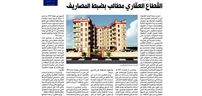
Property Companies Required to Control Expenses and Develop Advanced Investment Techniques to Survive Potential Fluctuations
Real estate sector impacted by market volatility – current circumstances provide resilient companies with valuable investment opportunities
The real estate business has been impacted by a number of factors that have a bearing on the sector’s performance, driving it up and down due to market volatility. Moreover, the recession suffered by some of the region’s real estate markets has decreased the number of property projects being launched and increased estimated costs.
Al Mazaya Holding’s Weekly Report stated that 2017 will witness a continued deceleration in terms of performance that is likely to get a number of companies to increase their capital to pare their costs or opt for mergers to create robust economic entities with firms that have similar platforms in order to reduce operating costs and mitigate losses sustained by local and regional equity markets and shareholders.
The report expected a state of precarious stability to prevail over the region’s real estate landscape during 2017 as a result of persisting economic pressures. These pressures are predicted to curb the growth of real estate companies listed on GCC stock markets. The economic challenges besetting the region and other parts of the world are not the only determinants of firm performance, said the report, noting that rising costs, expenses and the inability of some companies to ensure sound project management and revenues have a direct bearing on the property market’s overall performance.
The report underlined the necessity of reviewing the property sector’s performance over the past five years and pinpointing causes behind positive and negative performances that affect the industry status in the region’s stock markets.
The report shed light on the annual performance of real estate companies in Saudi Arabia, six of which registered negative results on the Saudi stock market, while three only posted positive results at the end of 2016. The building and construction companies did not fare better – eight companies recorded negative results while only nine recorded positive growth by the end of the year.
The declining annual profits of Saudi property markets are attributable to rising Zakat allocations and growing business cost hikes. Decreasing rental revenues and occupancy rates as well as increasing financing, marketing, administrative and taxation costs likewise have their direct bearing on the overall performance, said the report.
In the UAE, there is a discrepancy between stock market performance and the overall performance of property companies where results are better than those recorded at other markets, which proves that UAE property companies have managed to control operating and non-operating expenses to reduce overall projects costs. Within this context, seven UAE property companies listed on the local stock markets posted positive annual growth by the end of 2016, with only five ending on a low note in terms of operating revenues. The majority of property firms in the UAE have booked overall profits amounting to 2.5% by the end of 2016 comparatively with the same period in 2015.
On the other hand, the Qatari property market recorded lower profits in 2016 than in 2015 as a result of declining operating revenues and losses associated with sales of existing financial assets as well as the rise in selling and marketing expenses. The achieved profits include non-recurrent sources, property sales, and real estate investment appraisals.
The rise in property products and plot lands in Qatar has led to real estate deceleration and negatively affected real estate company performances, including those listed and de-listed on equity markets. Concurrently, company performances have not been affected by falling oil prices and rising costs of energy by-products.
The report mentioned that the results achieved by Gulf property markets are attributed to the nature of competition on the market over the past and current years, with a growing state of awareness as companies prefer not to go for investments whose economic returns are difficult to anticipate due to growing pressures besetting the market. This, in turn, may impinge on their ability to launch new enterprises that require modern expertise and techniques.
Government spending over the past few years has not been widely supportive of property development companies, which, as a result, have opted for concentrating their activities on projects launched by state governments from time to time. And until now, no significant changes have been confirmed by governments with regards to their spending polices in a way that could reflect positively on property companies by the end of 2017.
Further, the report also highlighted a decline in the number of property projects, in terms of value and volume, and a government tendency toward privatisation, indicating that such trends have their bearing on the decision of cash holders and on long-term investments. Therefore, this may generate further complications that are likely to negatively affect economic platforms, primarily the real estate sector.
In addition, economic deceleration is likely to reduce property rates, which ultimately means declining business returns. However, the current situation creates an opportunity for companies with resilient financial positions and sufficient liquidity to seize genuine investment opportunities and secure good returns at the regional and global levels.
In conclusion, the report called upon property companies to adopt modern and more efficient investment techniques as well as unify efforts if they are to pare cumulative losses, survive current business pressures and challenges in order to maximise financial returns. They are also required to tap into new investment opportunities and launch income-generating projects regionally and globally in order to avoid further loses and control expenses.
Clippings