
This post is also available in: العربية (Arabic)
The real estate market is undoubtedly one of the most dynamic markets in the global scenario, and Al Mazaya Holding Company ensures that you remain updated about the latest developments and trends in the property market. We invite you to browse through our exhaustive media library to know more about global and regional markets so that you are in a position to make informed decisions when it comes to your property investments.
Gulf Magazine
Al Mazaya Holding, a Kuwait-based investor and developer of mixed-use projects in the GCC, has finalised a five-year development plan that will see the organisation expand internationally, a senior official said.
“We are planning to expand into United Kingdom and United States of America in 2017 as part of a five-year development and expansion plan that will see the organisation become a global entity,” Engineer Salwa N. Malhas, Al Mazaya Holding’s Chief Business Development and Marketing Officer, told Gulf Property in an exclusive interview.
“Al Mazaya Holding’s board has approved the strategic business plan for the next five years which will help us to become a global player.”
The business plan to expand in key international markets is a significant strategic move and comes at a time when most property markets in the GCC are undergoing a challenging time marked by lower demand and higher supply due to the insurgency in Syria, Iraq, Turkey and Yemen and lower oil price. Lower oil price has forced governments across the GCC to cut development spend to reduce widening budget deficit.
Since growth in the regional markets might be tough, the company would naturally look beyond the Gulf to increase profitability and strengthen shareholder value, analysts say.
“In 2016, low oil prices and deepening conflicts continue to weigh mightily on the economies of the Middle East North Africa and Pakistan (MENAP) region. Oil exporters are facing another year of heavily reduced oil export revenues, and require ongoing fiscal consolidation and reforms to cope with these losses and to diversify their economies away from oil,” said the latest Regional Economic Outlook report issued by the International Monetary Fund (IMF).
“Oil importers are experiencing uneven and fragile growth, and need to adjust to the challenges of spillovers from their oil-exporting neighbours and the threat from conflicts.”
The oil price drop since mid-2014 has been spectacular: prices have fallen nearly 70 per cent to about $40 a barrel.
“The outlook for lower oil prices implies weak oil revenues for years to come, dramatically reducing the capacity of governments to spend. Export receipts in MENAP oil exporters declined by $390 billion in 2015 (17.5 per cent of GDP),” IMF said.
“Despite a partial offset from reduced imports owing to subdued prices of non-oil commodities, the combined current account of the GCC and Algeria has reversed from a comfortable surplus to a projected deficit of about 8 per cent of GDP in 2016. The deficit of other MENAP oil exporters is projected to be 4.75 per cent of GDP this year.”
The current account is expected to improve only gradually over the medium term, as the oil price recovers somewhat and fiscal adjustment unfolds. Mirroring the large loss in export receipts, fiscal balances have deteriorated considerably.
The ample surpluses of the GCC countries and Algeria have turned into significant deficits, projected to average 12.75 per cent of GDP in 2016 and remain at 7 per cent over the medium term, despite the implementation of sizable deficit-reduction measures
For other MENAP oil exporters—those generally less reliant on oil but with smaller fiscal buffers—the combined deficit is projected to average 7.75 per cent of GDP in 2016, and gradually close by the end of the decade as oil output increases and conflicts are assumed to ease, it said.
Despite the current situation, Malhas, an engineer by profession and a seasoned real estate expert, remains confident and positive. She says, the region’s property market is more stable and matured now. “We feel the market has reached a stable situation and a state of maturity and the market conditions will be determined by real demand and supply,” she said. “In order to adjust to the new market reality, we have adjusted our sales strategy and rebuilt our sales team and sales operations to benefit from the new opportunities.”
Malhas has more than 20 years of experience in real estate development, business models and feasibility studies. She is Chief Business Development and Marketing and Sales Officer at Al Mazaya Holding. The role – held since January 2004 – entails, building, structuring, setting up and assessing the company business plan;sourcing and overseeing the development and growth of profitable new business; participating in tendering projects with government; conducting feasibility studies for different business opportunities, and corporate and project marketing.
“Our company has been doing well despite the current situation and we have recorded 157.6 per cent increase in the gross profit generated from operating activities amounting to KD16.14 million in 2015, compared to KD6.27 million in 2014,” she said.
“We are going ahead with all our projects announced earlier. Moreover, we are expanding, acquiring assets and building new projects. So, we are confident and possess a long-term view. The real estate markets in the Gulf will continue to grow – but the growth will be slow and steady and the growth will be sustainable.
“Developers and brokers will have to adjust to the new reality and grow along with the market.”
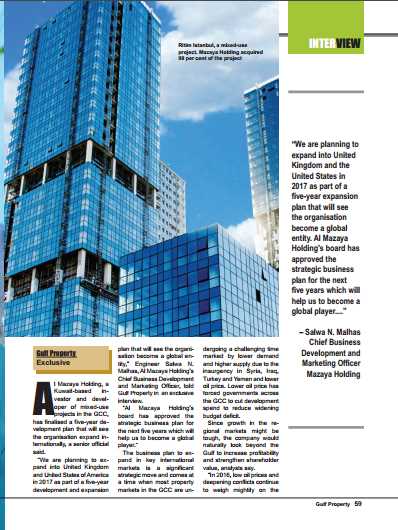
Al Mazaya Holding has recently acquired 50 per cent stake at Ritim Istanbul project in Turkey for $25 million, raising its share of the project to 90 per cent. The project, which is 98 per cent complete, was 85 per cent sold out. However, the move came barely two weeks after a failed military coup d’etat that had severely affected investor confidence. Mazaya might have benefited in its pricing from the growing uncertainty in the country – also due to a war across the border in its southern neighbour Syria.
Ritim Istanbul is considered a large property project on 39,000 square meters of land on the Asian side of Istanbul, and contains 6 towers with presidential and offices units. The mixed-use Istanbul project, with a current value of $400 million, includes 1,300 residential units and 400 retail outlets. Its retail complex is spread across over 22,000 square meters of land and includes 113 offices.
“It’s one of our best investment projects and has proven to be very profitable for us,” Malhas says.
Al Mazaya Holding, established in 1998, has emerged as a major player in the region’s real estate sector running 30 companies. The publicly listed company has recently reported a 21.77 per cent growth in net profits for the first half of the year to KD25.67 million, up from KD21.9 million recorded in the first half of 2015. The company’s assets totalled KD234 million at the end of the first half of 2016.
The company is set to invest in its second residential project in Oman. Mazaya Residences, a residential and commercial development, will boast of 300 residential units in various sizes and designs with prices starting from $98,000 onwards.
Strategically located in Mawaleh in Muscat, the project stands out as an attractive opportunity for GCC residents looking for investment or housing.
The company’s assets declined to KD234 million in June 2016, compared to KD265 million recorded in June 2015, which has resulted from the handover of units in Q Point project, which was included in the company’s statement of income of H1-2016. Correspondingly, shareholders’ equity amounted to KD106.6 million, in H1-2016, a 6.3 per cent growth compared to H1 2015.
The company’s total short term liabilities decreased to KD 119.7 million, in H1-2016, representing a 23.89 per cent fall over H1-2015 figures, attributing this decrease mainly due to the fact that company’s loans are transferred to medium and long term liabilities as well as some liabilities had been transferred to revenue, with payments being received from customers after the delivery of their residential units.
The company completed studies to develop a plot of land for investment in Al Sharq, Kuwait. An engineering consultant will now be appointed to commence the design and licensing works. It has continued construction work on its 17-storey medical facility in Sabah Al Salem. Contracting works have been awarded to a leading contractor. The project is 24 per cent completed and expected for delivery by the end of 2017.
Al Mazaya had achieved construction progress of 71 per cent on the first phase of its Queue Line Residential project, which consists of four new buildings, in Dubai Land, Dubai. The project is progressing well and the delivery of this phase of the project is expected by the end of 2016.
The company continued to achieve high occupancy rates in its income-generating projects, such as the 95 per cent occupied Sky Gardens, in Dubai International Financial Centre (DIFC), almost 100 per cent occupied Al Mazaya Towers (all 3 buildings), Kuwait City, and almost 100 per cent occupied projects, across KSA and Dubai.
The company has also achieved revenue increase from its portfolio of properties available for sale, such as the office space in Mazaya Business Avenue. In addition, the company sold and delivered a large number of residential units in Queue Point Dubai and Ritim Istanbul, in Turkey.
Al Mazaya had achieved construction progress of 71 per cent on the first phase of its Queue Line Residential project, which consists of four new buildings, in Dubailand, Dubai. The project is progressing well and the delivery of this phase of the project is expected by the end of 2016.
Al Mazaya is currently studying additional investment opportunities in the region and in international markets.
“We regularly monitor the changing developments in the financial and international markets and the impact they have on the region’s real estate sector,” Malhas said.